The Locomotive Pioneers by Burton Anthony;
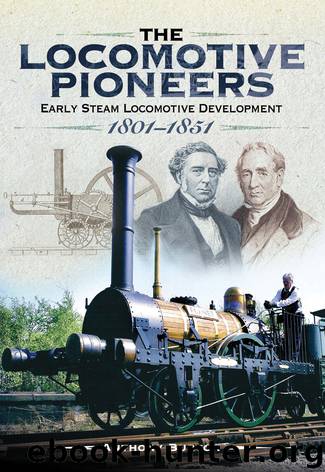
Author:Burton, Anthony;
Language: eng
Format: epub
Tags: TRANSPORTATION / Railroads / General
Publisher: Pen and Sword
Published: 2017-11-30T05:00:00+00:00
An account of the trials was given in the History of Baltimore City and County by John Thomas Scharf, published in 1881. The date of the trial had originally been set at 1 June 1831 but it was postponed and the first runs only took place on 12th July:
‘Only two competitors put in an appearance at the first trial, the ‘York’, manufactured by Davis & Gartner, at York, Pa., and an engine from New York City, the name of which is not recorded in the local chronicles. Another engine, built at Gettysburg, Pa., by George Welsh, had been entered for the prize, but it was not ready to take the track on the day finally set for the contest. At this exhibition the ‘York’ won all the honors. On the first trip it made a mile in three minutes, drawing a car containing forty persons, and rounded the curves without checking speed. Several trips were made, and the engine ran a mile in two minutes and a half on some portions of the road, After the Davis engine had astonished the assembled multitude with its splendid performance, the New York engine made a short trip, but it fell so far behind the competitor in the essential quality of speed that not much notice was taken of its merits, whatever they may have been.’
With the company now committed to steam, Peter Cooper reappeared, offering to build six locomotives. This was agreed but when he failed to supply the engines, the contract was withdrawn and he sold on his patent to the Baltimore & Ohio. Davis now took over the task of constructing an improved version of his original York engine. He was helped by Ross Winans, an engineer who had worked with Cooper in developing Tom Thumb. The new engine, named Atlantic, was completed in 1832. Once again, the engine had a vertical boiler and two cylinders, but a very different drive arrangement. The crossheads above the cylinders connected to oscillating beams, from which the two long connecting rods led down to a cranked axle. A gear on the axle, engaged with a second, smaller gear that provided the drive to the two pairs of connected wheels. The motion of the beams and their connecting rods seemed like those of an insect’s legs, so that the locomotives of this type were known as ‘Grasshoppers’. Atlantic was a success, maintaining an average speed of 13mph over an 82-mile run that included comparatively steep gradients, up to 1:93. Altogether some twenty Grasshoppers were built, though the design was improved over the years.
In 1832, Davis went for a trip on a Grasshopper on the recently opened Washington branch of the line. He had got into the tender so that he could have a good view of the working of the locomotive and then the engine derailed. The following coaches crashed into the tender, and Davis was killed. Winans was to carry on his work with the Baltimore & Ohio, continuing to develop vertical boiler engines.
Download
This site does not store any files on its server. We only index and link to content provided by other sites. Please contact the content providers to delete copyright contents if any and email us, we'll remove relevant links or contents immediately.
Whiskies Galore by Ian Buxton(42154)
Introduction to Aircraft Design (Cambridge Aerospace Series) by John P. Fielding(33244)
Small Unmanned Fixed-wing Aircraft Design by Andrew J. Keane Andras Sobester James P. Scanlan & András Sóbester & James P. Scanlan(32872)
Aircraft Design of WWII: A Sketchbook by Lockheed Aircraft Corporation(32382)
Craft Beer for the Homebrewer by Michael Agnew(18342)
Turbulence by E. J. Noyes(8201)
The Complete Stick Figure Physics Tutorials by Allen Sarah(7476)
The Institute by Stephen King(7151)
The Thirst by Nesbo Jo(7096)
Kaplan MCAT General Chemistry Review by Kaplan(7051)
Bad Blood by John Carreyrou(6727)
Modelling of Convective Heat and Mass Transfer in Rotating Flows by Igor V. Shevchuk(6532)
Weapons of Math Destruction by Cathy O'Neil(6465)
Learning SQL by Alan Beaulieu(6400)
Man-made Catastrophes and Risk Information Concealment by Dmitry Chernov & Didier Sornette(6217)
Permanent Record by Edward Snowden(5951)
Digital Minimalism by Cal Newport;(5919)
Life 3.0: Being Human in the Age of Artificial Intelligence by Tegmark Max(5685)
iGen by Jean M. Twenge(5506)
